
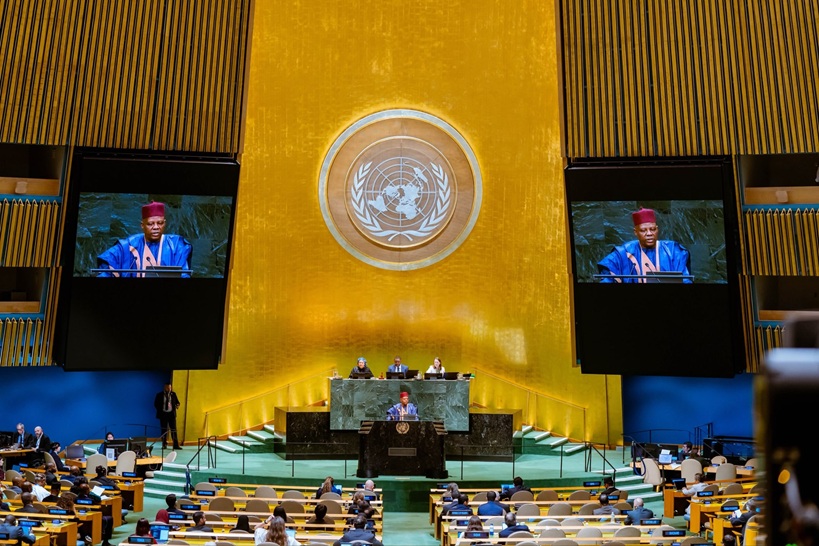
 President Bola Tinubu has renewed Nigeria’s call for permanent representation on the United Nations Security Council, saying Africa cannot continue to feature prominently on the council’s agenda while remaining excluded from its permanent membership.
Tinubu, represented by Vice President Kashim Shettima at the 81st UN General Assembly, said Nigeria supports the reform of the Security Council to reflect the realities of the contemporary world rather than the balance of power in 1945.
He called for at least two permanent seats for Africa, with full rights and responsibilities, including veto powers for as long as the veto exists, as well as five non-permanent seats for the continent.
The President said Nigeria was ready to assume greater responsibility in global affairs, citing its contributions to peacekeeping and conflict resolution in Liberia, Sierra Leone, Darfur, Mali and The Gambia.
Tinubu also urged stronger international action on climate change, calling for climate finance, technology transfer and capacity building to enable developing countries to pursue low-carbon development without compromising economic growth.
He said Nigeria remained committed to achieving net-zero emissions by 2060 while expanding access to affordable and reliable energy through renewable energy, clean cooking, gas as a transitional fuel, climate-smart agriculture and nature-based solutions.
On artificial intelligence, Tinubu urged responsible deployment of the technology, saying Nigeria was investing in digital infrastructure, broadband connectivity, research, innovation and technology entrepreneurship.
He further called for reforms to the international financial architecture, wider access to concessional financing and sustainable debt frameworks to ease the burden on developing countries.
The President highlighted the African Continental Free Trade Area as a major opportunity to deepen regional integration, expand intra-African trade, promote industrialisation and move the continent from exporting raw materials to value-added production and technology-driven growth.
On security, Tinubu said Nigeria’s experience in combating Boko Haram, ISWAP and other armed groups had shown that military action alone could not guarantee lasting peace without education, economic opportunities, accountable governance and protection of citizens’ rights.
He also called for urgent diplomacy to address conflicts in Sudan and other war-affected countries, urging all parties to protect civilians, uphold international humanitarian law and facilitate humanitarian assistance.
Tinubu said the United Nations must strengthen peacekeeping, peacebuilding, mediation and institution-building, while dedicating greater resources to conflict prevention.
He concluded by reaffirming Nigeria’s commitment to multilateralism, dialogue and international cooperation, describing a reformed and inclusive United Nations as essential to achieving a peaceful, just and sustainable world.
Tinubu Urges IOCs To Give Indigenous Firms More Contracts
Federal Government Assures Nigerians Of Capacity To Contain Ebola
Ondo Governor Mourns Elder Statesman Reuben Fasoranti At 100
FG Confirms Ebola Case In Abuja, Traces 44 Contacts