
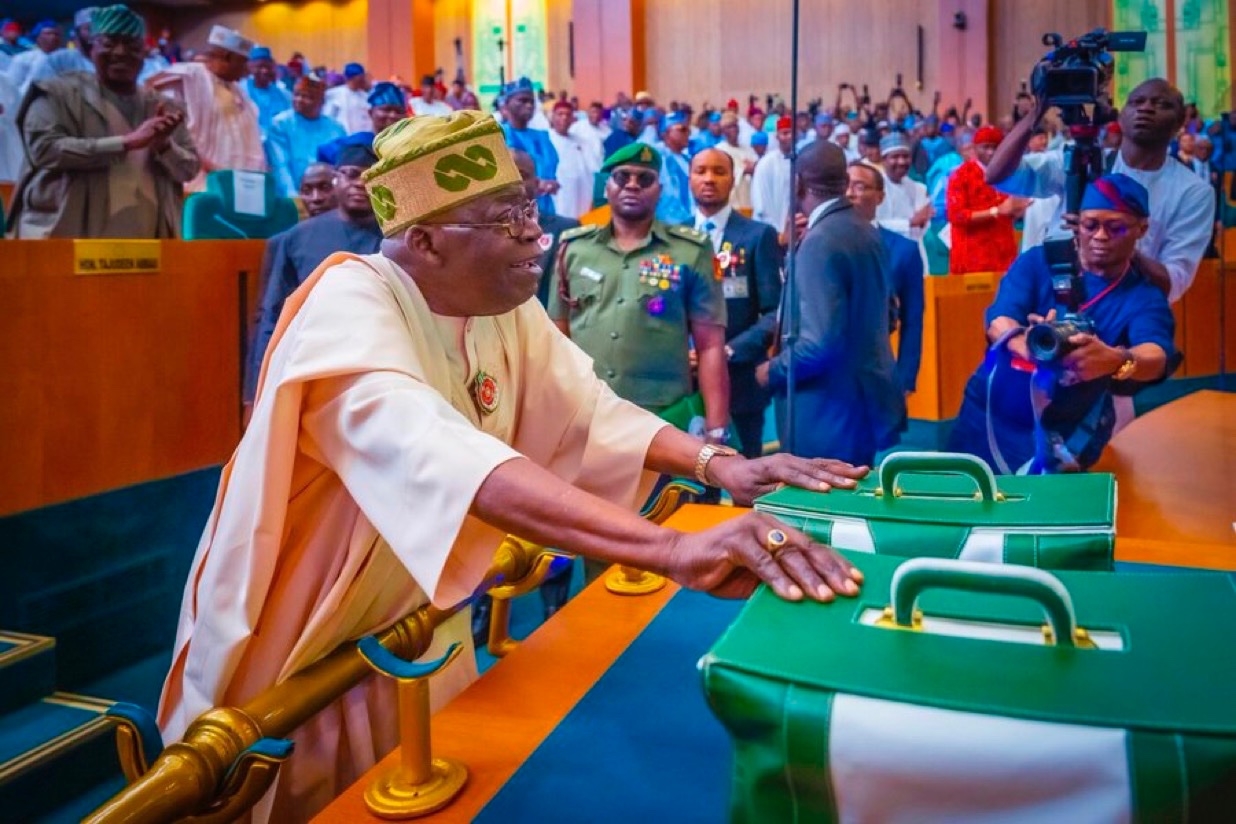
 President Bola Tinubu on Friday presented a ₦58.1 trillion budget proposal for the 2026 fiscal year to a joint session of the National Assembly, outlining his administration’s fiscal, security and economic priorities.
The proposal pegs capital expenditure at ₦26.08 trillion and recurrent (non-debt) spending at ₦15.25 trillion. It is based on a crude oil benchmark of $64.85 per barrel, production of 1.84 million barrels per day, and an exchange rate of ₦1,400 to the dollar.
Tinubu said projected revenue stands at ₦34.33 trillion, while total expenditure is estimated at ₦58.18 trillion, including ₦15.52 trillion for debt servicing. The budget deficit of ₦23.85 trillion represents 4.28 per cent of GDP.
Defence and security received the highest allocation of ₦5.41 trillion, followed by infrastructure at ₦3.56 trillion. Education was allocated ₦3.52 trillion, while health received ₦2.48 trillion. The proposal is titled “Budget of Consolidation, Renewed Resilience and Shared Prosperity.”
Addressing lawmakers, the president said the budget reflects national priorities. “They are a statement of national priorities,” he said, adding that his administration remains committed to fiscal sustainability and transparency.
With insecurity persisting in parts of the country, Tinubu said security “remains the foundation of development,” outlining plans to modernise the armed forces, strengthen intelligence-driven policing and improve border security.
He acknowledged the hardship caused by reforms such as fuel subsidy removal and the floating of the naira but said the economy has begun to stabilise. “I commend the understanding, sacrifice, and resilience of our people,” he said.
Tinubu also pledged increased investment in infrastructure and agriculture, stressing that “food security is national security,” with the budget prioritising mechanisation, irrigation, storage, processing and agro-value chains.
Tinubu Approves Procurement Of Additional Military Hardware To Fight Terrorism
Over 3.7 Million Internally Displaced Persons Living In Nigeria – IOM
Court Restrains Gov. Lucky Aiyedatiwa From Seeking Re-Election
Senate Confirms Taiwo Oyedele As Minister Of State For Finance