
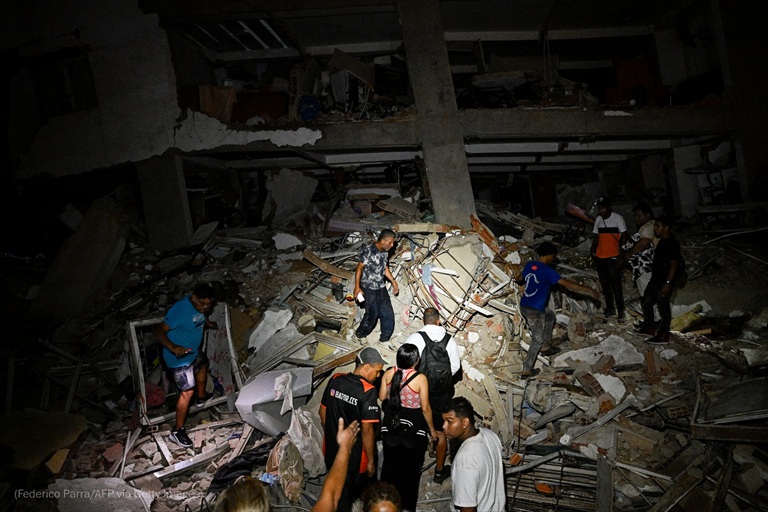
The death toll from two powerful back-to-back earthquakes that struck northern Venezuela on Wednesday night has risen to at least 235, with more than 4,300 people injured and tens of thousands reported missing. Rescue operations continue amid widespread destruction, as officials warn the final casualty figures could rise significantly.
The earthquakes, measuring 7.2 and 7.5 in magnitude, struck just 39 seconds to one minute apart. The stronger 7.5 quake is the most powerful to hit Venezuela since 1900. The tremors caused severe damage in the capital Caracas and the coastal state of La Guaira, where dozens of buildings — including a 13-storey tower block in Playa Grande — completely collapsed.
Hundreds of buildings have been damaged or destroyed, leaving thousands homeless. Residents described terrifying scenes: buildings swaying violently, people trapped in high-rise apartments and underground car parks, and families forced to sleep in public squares and streets.
The US Geological Survey (USGS) has warned that the death toll could climb into the thousands, with modelling suggesting a significant risk of exceeding 10,000 fatalities depending on the extent of trapped survivors and aftershocks.
Venezuelan Acting President Delcy Rodríguez has declared a state of emergency, deployed the military, and mobilised heavy machinery to clear rubble in the hardest-hit areas. Priority is being given to restoring access routes and delivering water, food, blankets, and shelter.
International aid is mobilising rapidly. The United States is deploying specialised urban search-and-rescue teams (DART), military aircraft, and substantial financial assistance exceeding $200 million through partners and UN channels. Other nations including Mexico, Spain, Colombia, the UK, Qatar, China, and Russia have pledged rescue teams, medical support, and funding. Starlink has offered free satellite internet for a month, and NGOs such as the Norwegian Refugee Council have described the situation as an “enormous catastrophe” compounding Venezuela’s pre-existing humanitarian challenges.
The quakes have exacerbated an already fragile political and humanitarian situation in Venezuela. Aid groups are particularly concerned about shelter needs, sanitation, disease prevention, and psychological support for children. Aftershocks continue to rattle the region, adding to the danger for rescue workers and displaced residents.
Search and rescue operations remain ongoing, with officials stressing that the coming hours and days will be critical in determining the final toll.
OpenAI Reveals Six Concerning AI Behaviour Incidents
Trump Threatens European Union With Tariffs Over Canada Partnership
US Imposes Visa Restrictions On South Africans Over Afrikaner Claims
NATO Jets Shoot Down Drone In Lithuanian Airspace