
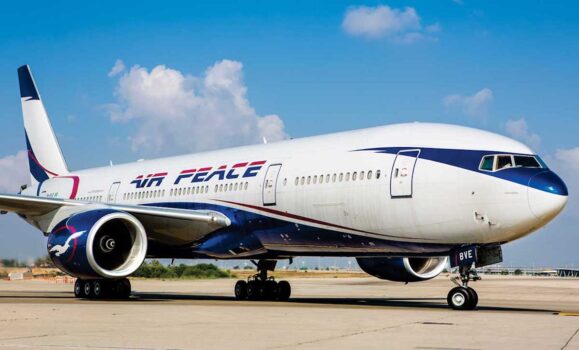
 Air Peace has disputed the Nigeria Civil Aviation Authority’s (NCAA) August 2026 flight disruption report, alleging inaccuracies in the airline’s flight volume data and attributing the majority of its delays during the month to external factors.
In a statement signed by its Chief Operating Officer, Oluwatoyin Olajide, the airline said it operated 2,564 flights in August, compared with the 1,864 flights recorded in the NCAA report.
Air Peace said the omission of more than 700 flights from the NCAA’s data pool distorted its performance metrics and resulted in an inaccurate representation of its delay rate.
The airline also questioned the timing of the NCAA’s monthly report, noting that the August data was released 13 days after the end of the month, while it said equivalent July data was not available following the publication of the first and second-quarter reports on July 31.
Air Peace further argued that the report failed to adequately account for the operational impact of disruptions arising from industrial action by aviation unions from August 11.
According to the airline, the disruption affected its operations for more than 14 days, resulting in flight rescheduling, delays and cancellations.
Air Peace said an internal review of its August operations showed that 391 flights, representing about 15 per cent of its delays, were attributable to internal factors.
It identified technical issues requiring unscheduled maintenance and fuel-related challenges as the major internal causes of delays.
The airline attributed the remaining delays to external factors, including airport congestion and traffic, bird strikes, airport infrastructure failures, adverse weather, industrial action and damage to aircraft by a ground-handling company.
Air Peace said airport congestion and traffic accounted for more than 51 per cent of its external delays, with aircraft frequently held on the ground or in holding patterns because of infrastructure capacity constraints.
On bird strikes, the airline cited an incident involving its aircraft, 5N-BYG, in Abuja. It said the aircraft suffered damage to its inlet cowl and was removed from service for more than a week while repairs were carried out at a cost of $1.8m.
The airline said the aircraft normally operated at least eight sectors daily and carried about 1,000 passengers, adding that its removal from service contributed to operational disruptions.
Air Peace also cited adverse weather conditions and flight diversions as significant sources of consequential delays, arguing that such disruptions were beyond the airline’s control.
The airline said it continued to provide support to affected passengers, including hotel accommodation, even when disruptions were caused by external factors.
Air Peace maintained that the NCAA report’s attribution of delays to the airline failed to sufficiently distinguish between internal operational challenges and disruptions caused by circumstances outside its control.
The airline said it had invested significantly in fleet expansion, crew availability, training and maintenance protocols, while acknowledging the need to continue improving its internal processes.
It urged the NCAA to review and audit its data collection methodology to ensure future reports accurately reflect airline flight volumes, delay causes and the broader operational environment in Nigeria’s aviation sector.
“We remain fully committed to safety, on-time performance and passenger satisfaction; however, an airline cannot safely or logistically bypass severe airport congestion/traffic, inadequate airport infrastructure, sunset restrictions or adverse weather conditions,” Olajide said.
Dangote Refinery Extends IPO Closing Date To October 27
United States Names 24 Nigerians Arrested Over Alleged Crimes
Tinubu To Flag Off 2027 Re-election Campaign In Kaduna October 24
NLC Gives FG Two Weeks To Cut Petrol Price, Renegotiate Minimum Wage