
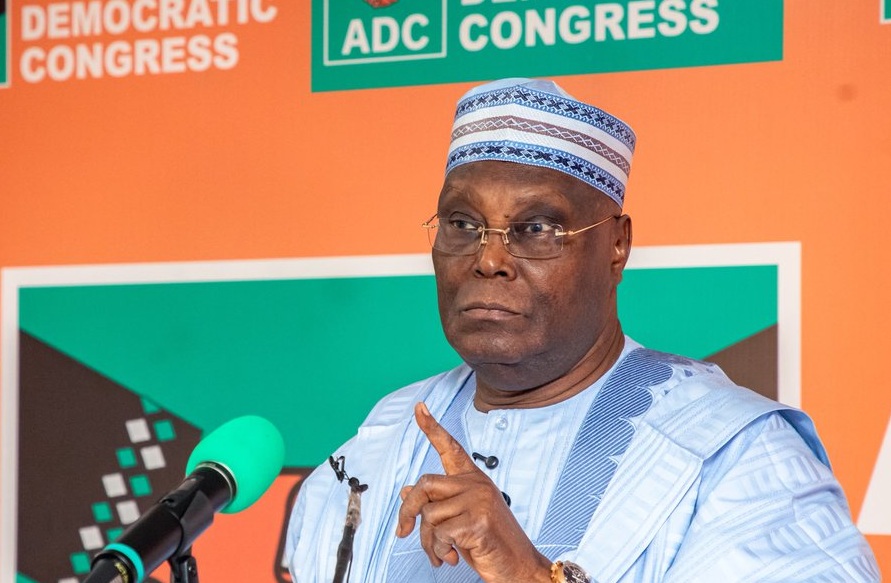
 Former Vice President Atiku Abubakar has used Nigeria’s 66th Independence Anniversary to deliver a sharp critique of President Bola Tinubu’s administration, accusing it of plunging the country into its worst cost-of-living crisis while failing to protect lives and livelihoods.
In a speech delivered on October 1, 2026, at the African Democratic Congress (ADC) headquarters in Abuja, Atiku, the party’s presidential candidate for the 2027 elections, said millions of Nigerians are struggling for basic necessities that a free nation should guarantee: food, a living wage and personal safety.
He blamed the removal of the fuel subsidy without adequate social protection for driving up the cost of petrol, transport and food. Citing specific figures, Atiku noted that a ₦30,000 minimum wage in April 2023 could buy about 118 litres of petrol, while today’s ₦70,000 wage buys only about 50 litres. The average price of an egg rose from roughly ₦88 to ₦261, and a loaf of bread increased from about ₦500 to ₦2,000 for a smaller size.
“While Nigerians are lectured about hardship, those in power preside over brazen waste, corruption and a budget process that makes a mockery of fiscal discipline,” he said. He repeatedly challenged Tinubu’s claims that the “emergency treatment is over” and that an “age of prosperity” has begun, asking: “Bola, where is the benefit?” and “Bola, where is this prosperity?”
Beyond the economy, Atiku highlighted insecurity, saying armed groups have killed thousands, displaced communities and forced farmers from their fields. He described a government unable to make life affordable or protect lives as having failed the two most important tests of leadership.
On policy, Atiku outlined his alternative: a capped, budgeted production subsidy linked only to fuel refined in Nigeria, including modular refineries. Imported petrol would not qualify. He promised independent audits, publication of costs and cuts in government waste to fund the programme, arguing that producing and refining locally would create jobs and lower pump prices.
He also criticised several other areas of governance, including:
– The award of the Lagos–Calabar Coastal Highway contract to a Chagoury Group company without open public tender, calling for full disclosure of the bidding process.
– Unpaid local contractors who completed government projects and now face financial ruin.
– Rising public debt and plans for further borrowing without clear accountability for previous loans.
– Claims of large-scale cash transfers that, he said, lack transparent verification.
– Budget confusion, with multiple budgets running concurrently.
– Political detentions and the need to uphold due process, rule of law and free expression.
– Election integrity, pledging that if elected he would end rigging, respect INEC’s independence and ensure results are published promptly from every polling unit.
Atiku rejected the idea that Nigerians must simply endure more pain, insisting that despair is not a strategy. He said his administration would prioritise affordability, security, healthcare, education and accountable public spending from day one.
“Our founders did not win sovereignty so that a few could prosper while millions merely survive,” he declared. He ended with a direct political message: Nigerians have the power to choose a different course through the ballot, and “Tinubu must go.”
Happy Independence Day, he concluded, praying for God’s blessing on the Federal Republic of Nigeria.
APC Unveils Membership Of 2027 Presidential Campaign Council
Atiku Slams Tinubu’s 30-Day Fuel Discount As Election-Driven Publicity Stunt
Nigeria At 66: Peter Obi Calls For Honest Reflection And A New Path
Atiku Appoints El-Rufai Deputy Campaign Council Chairman