
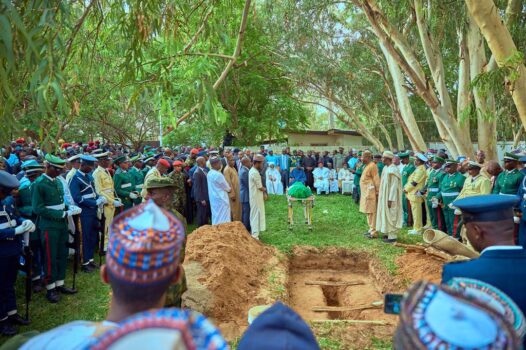
 Nigeria on Tuesday paid its final respects to former President Muhammadu Buhari, who was buried with full military honours in the backyard of his home in Daura, Katsina State. The 82-year-old leader passed away on Sunday in a London hospital after a prolonged but undisclosed illness.
A military parade and 21-gun salute marked the solemn farewell at the Umaru Musa Yar’Adua International Airport in Katsina, where his casket, draped in the national green and white colours, was received by President Bola Ahmed Tinubu, Vice President Kashim Shettima, federal cabinet members, and visiting African dignitaries.
Following the airport ceremony, Buhari’s body was transported by motorcade 80 kilometres to Daura. Crowds of mourners lined the streets, some climbing trees and chanting “Sai Baba” as the cortege passed. The burial was conducted in accordance with Islamic rites, with clerics leading the Janazah prayer before the casket was lowered into the ground in a private ceremony within his residence.
President Tinubu declared a seven-day national mourning period and a public holiday in honour of the late statesman. Flags across the country are flying at half-mast. A federal committee led by Secretary to the Government of the Federation George Akume was tasked with overseeing the funeral arrangements and related state activities.
Muhammadu Buhari served Nigeria as military head of state from 1983 to 1985 following a coup and later returned to power as a civilian president in 2015, defeating incumbent Goodluck Jonathan. He won re-election in 2019 and completed his second term in 2023.
Though hailed for his anti-corruption stance, large-scale infrastructure projects, and commitment to public discipline, Buhari’s presidency was marked by significant challenges. His administration faced persistent insecurity, economic recessions, a crisis in the oil sector, and criticism over prolonged medical absences abroad.
Despite these issues, Buhari remained a revered figure in many parts of northern Nigeria, where he was often seen as a principled and austere leader who prioritized national integrity and security.
His burial drew a broad cross-section of mourners, from former Vice President Yemi Osinbajo and ex-President Goodluck Jonathan, to party loyalists and citizens who travelled from across the region to pay their final respects.
With the conclusion of the burial, Nigerians reflect on the legacy of a leader who played a central role in shaping the country across four decades—from military rule to democratic governance—leaving behind a complex but undeniable imprint on the nation’s political history.
LPPC Suspends Mike Ozekhome’s SAN Rank Pending Disciplinary Proceedings
Senate Passes State Police Bill, Moves Constitutional Amendment Forward
Lagos Police Foil Shipment Of Military Uniforms, Drugs To South-East
Makinde Imposes 16-Hour Curfew In 10 Oyo LGAs Over Security Concerns